)
)
)
AEW 2024: Rosatom’s SMR Technology can Drive Africa’s Just Energy Transition
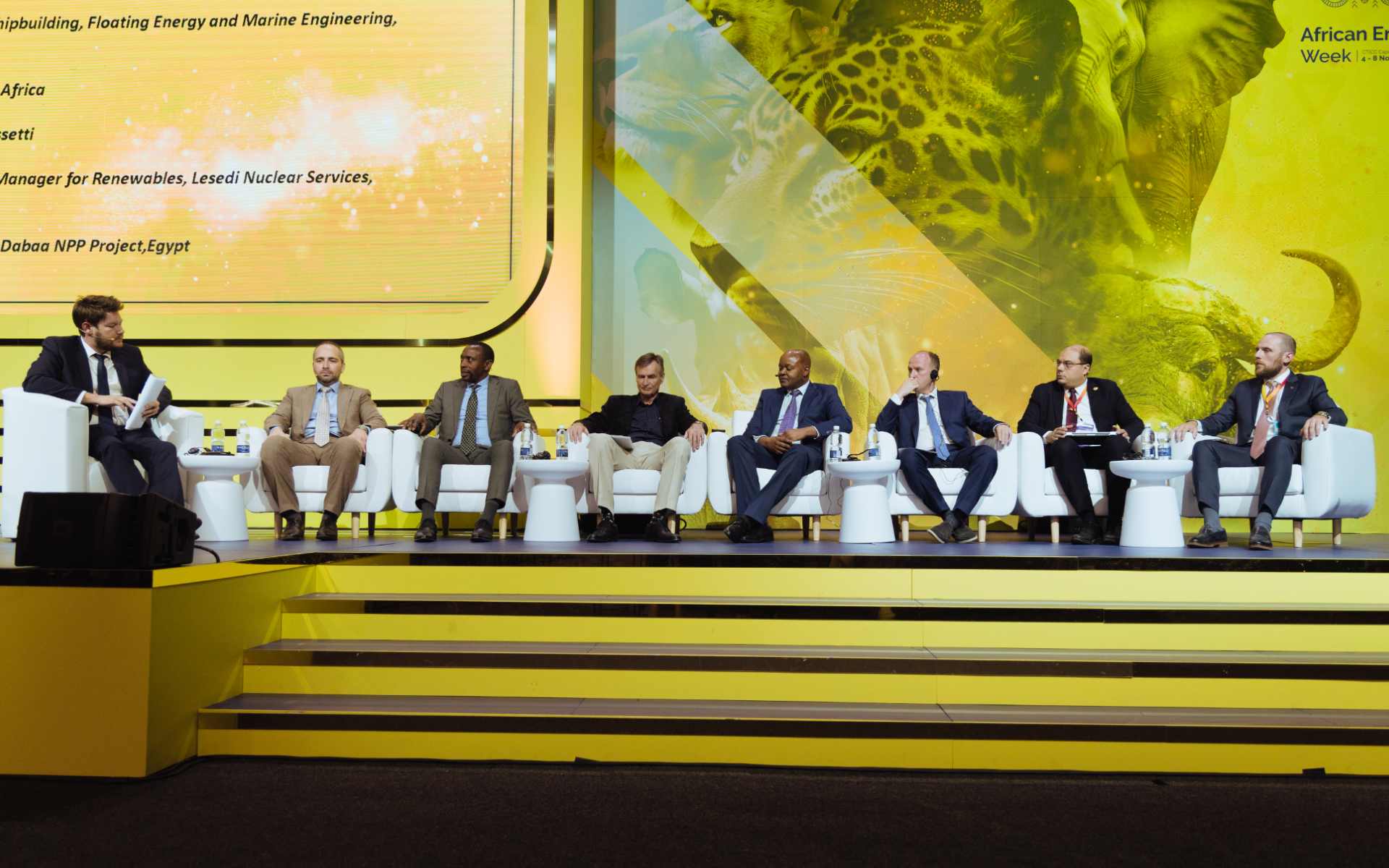
As African nations pursue a just energy transition, a Rosatom-sponsored panel discussion at African Energy Week: Invest in African Energies 2024 explored the role a multi-energy strategy plays in ensuring accessible, affordable and reliable energy. In this strategy, nuclear energy has emerged as a promising solution, particularly for countries such as South Africa and Egypt.
South Africa – which currently hosts Africa’s only operational nuclear facility – has ambitions to scale-up its nuclear capacity in line with its just energy transition targets. The country has long-faced challenges regarding generational capacity and strives to not only substantially increase this capacity but reduce the reliance on coal-fired power – representing 83% of its energy mix.
Loyiso Tyabashe, Group CEO of the South African Nuclear Energy Corporation, said “We hear many stories of nuclear being expensive in the beginning, but to operate in the long-term, it’s the cheapest form of energy. The central aspect of the energy transition in Africa is accessibility and affordability.”
Rosatom offers a solution to Africa’s energy and climate needs through the deployment of Small Module Reactors (SMR) and floating nuclear stations. According to Vladimir Aptekarev, Deputy General Director for Shipbuilding, Floating Energy and Marine Engineering at Rosatom’s Mechanical Engineering Division Atomenergomach JSC., “floating power units are actually the fastest and simplest way to go. They offer more flexibility, are smaller and you can adjust the whole system by adding additional barges. The business model is unique.”
Bheki Nxumalo, Group Executive for Generation at South Africa’s state-utility Eskom noted that “SMRs are a perfect technology for us as we decommission the country’s coal stations. We cannot just switch off a power station; we need a plan. Together with solar photovoltaics and storage and in terms of baseload, SMRs are a critical technology for us in the future.”
In Egypt, Rosatom is developing a large-scale nuclear facility that is poised to account for up to 50% of the country’s power generation capacity. Representing the company’s first major nuclear power plant in Africa, the $30 billion El-Dabaa Nuclear Power Plant project will have a capacity of 4.8 GW once it becomes operational by 2030.
El-Dabaa Nuclear Power Plant Project Manager Mohammed Saad Dwiddar, explained that “We believe that this project will play a vital role in Egypt’s efforts to have a sustainable and just transition. The project will not only contribute towards meeting sustainable energy goals but it will be part of a much boarder industrial strategy.”
The project is just one of several initiatives that Rosatom is planning across the continent. The company has signed a string of deals in recent months with African nations on the peaceful cooperation of nuclear power development and knowledge-sharing. Deals were singed with Republic of Congo, Guinea-Conakry and Burkina Faso.
However, to meet both climate and energy-related goals, Africa will require a multi-development approach, whereby the continent utilizes all of its available energy resources. Evgeny Lyapunov, Chairperson of the Board of Directors at Rosetti, outlined how Russia’s energy model can be adopted in Africa.
He explained that Russia prioritizes the development of energy resources based on regional factors such as availability and market access. “In Africa, we need to use the same balanced approach,” he said. “The changes in the energy system must be balanced. This model will have a significant impact on the sustainability and reliability of the system. We need to find a balance between reliability and climate requirements.”
As such, countries such as South Africa are adopting an integrated resource approach, aimed at leveraging a variety of energy solutions. Grigory Khanbekyan, Director, Unigreen Energy SA, explained that South Africa has led in terms of solar installations. He said, “More than 47% of [total] solar installations in Africa – 7.8 GW – have been in South Africa. Over the last 10 years, South Africa has managed to create a highly-competitive solar industry.”
In terms of financing, South Africa faces a critical challenge. Johan Groenevald, Project Business Development Specialist, Lesedi, says that “If we look at what is required for South Africa’s just energy transition, we need to spend R1.5 trillion between 2023 and 2027. To be able to afford these types of investments, we would need multiple sources of financing, including private investment, Development Finance Institutions, multilateral development banks, and more.”
By utilizing various funding and energy solutions, Africa will be well-positioned to drive a just energy transition, therefore making tangible progress in meeting both climate and energy goals.