)
)
)
AEW Future Leaders Student Challenge Recognizes Innovative Solutions to South Africa’s Energy Crisis
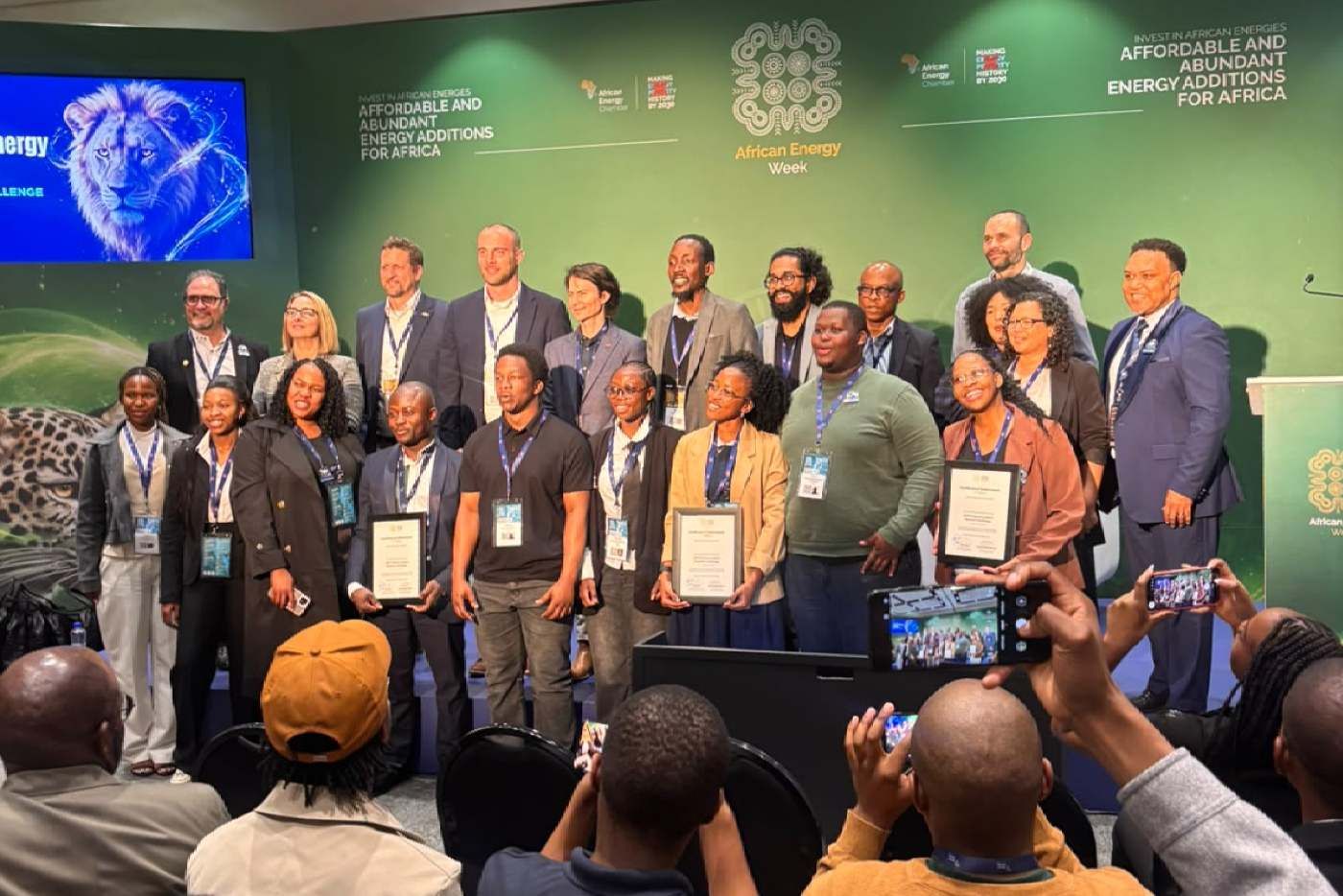
The African Energy Week (AEW) Future Leaders Student Challenge placed reliable and affordable electricity in Southern Africa at the center of a university competition, asking students to develop practical solutions as the region’s power systems change.
The winning entry was Team Cobalt, who proposed putting the country’s electricity carbon tax to work. The project aims to move free electricity for the poorest homes and introduce new power supply for the country, with no new tax. Since power stations already pay a carbon tax, the project proposes that the government sets aside a fund of R6.2 billion a year, capped in a law, with first transfers from April 2028. The fund will incorporate R1.86 billion (30%), directed toward households, while RR4.34 billion (70%) will be directed towards new power supply. This represents around 1.75% of Eskom’s revenue.
Second place was awarded to Team Rubidium, who introduced Kgalagadi Axua Intelligence (KAI), an initiative to roll-out solar technology and improve smart water management, particularly across farms country-wide. They posed a challenge faced by communities in the Northern Cape, whereby access to water has been impacted by ongoing fuel shortages and the anticipated El Nino weather disruptions. Through KAI, farmers will have access to financing options and solar infrastructure to ensure stable water supply.
Third place was awarded to Team Chromium, who posed a conditional retirement framework for the Camden Power Station, which was initially projected to close in 2030. The team introduced a five-test solution before units such as this retire, including testing financial close; replacements of metered output; dependable supply; the network; and accounting for the people in the area.
Created by the African Energy Chamber in collaboration with the University of Cape Town (UCT), Stellenbosch University, the University of the Western Cape (UWC), Cape Peninsula University of Technology (CPUT) and the University of Pretoria (UP), the program connected academic knowledge with electricity challenges affecting communities, businesses and public institutions. Up to 150 students participated in the session.
Against a backdrop of ageing power stations, replacement generation, storage requirements and changing electricity networks, each team selected a real problem affecting a particular place, organization or community. Proposals involved technical innovations, business models, policy measures or social interventions. Teams were required to explain who would benefit, how their ideas could be funded and implemented, and how success would be measured.
The judging panel brought together expertise in engineering, energy law, renewable energy integration, business development and resource governance. Judges included UCT energy law researcher Dr Lindsay Taylah Moses, Stellenbosch electrical engineering lecturer Dr Armand du Plessis, C STAR Holdings COO Dr Wijnand Marquart, among others. Their backgrounds connected the assessment with policy requirements, power-system performance and the commercialization of university research.
Students listed in the program represented institutions including the UCT, Stellenbosch University, the UWC, CPUT, the UP and Emeris’ Newlands Campus. Linking the competition with AEW’s conference, exhibition and industry network provided a platform for emerging talent to engage with decision-makers, explore career opportunities and present ideas beyond the university environment.