)
)
)
IOCs Call for Regulatory Interventions to Streamline Upstream Investment in South Africa
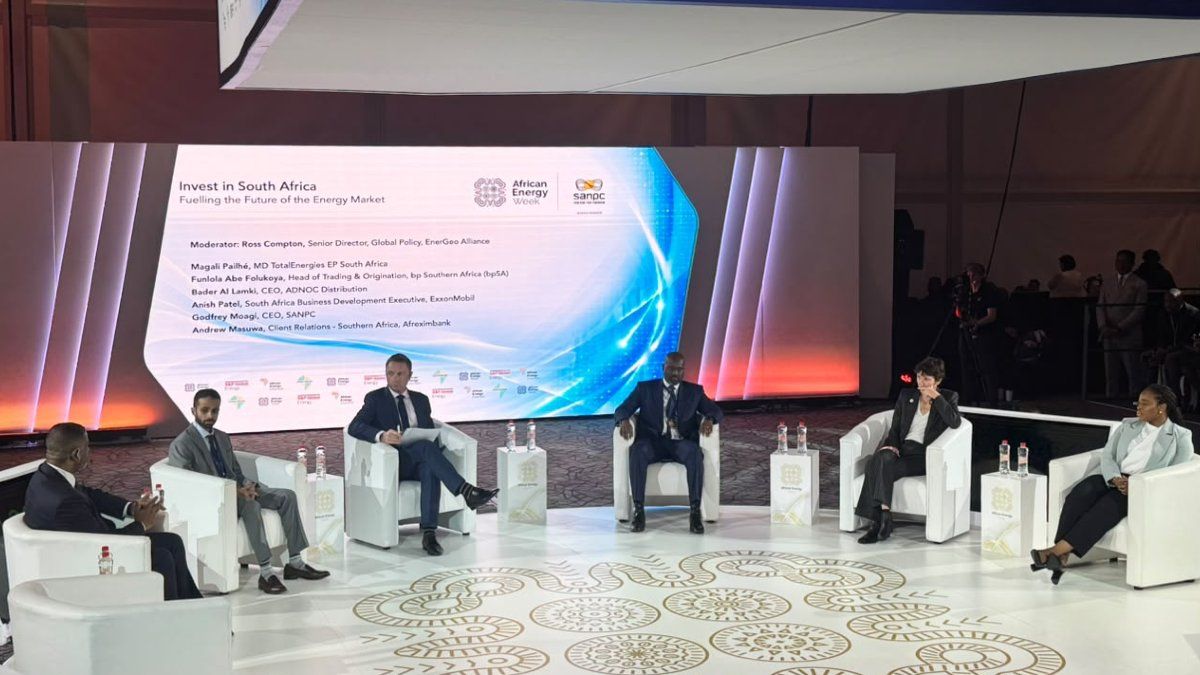
International oil companies active in South Africa have called for government intervention to streamline regulations and address appeal-related licensing delays that continue to constrain investment in the country’s upstream sector. Speaking during a panel discussion sponsored by the South African National Petroleum Company (SANPC) at African Energy Week (AEW) 2026, industry leaders highlighted the need for predictable policy, infrastructure investment and faster project approvals to unlock South Africa’s petroleum potential.
Magali Pailhé, Managing Director of TotalEnergies EP South Africa, identified regulatory appeals as a major obstacle to offshore exploration, contrasting South Africa’s limited drilling activity with neighboring Namibia.
“Today, we have blocks offshore in the Orange Basin that TotalEnergies has proven in Namibia, but are blocked in various stages of appeal. We need to unblock these so the potential can be realized,” she said. “In Namibia, 25 wells have been drilled since 2022, while in South Africa, only three since 2014. The industry is here, but the appeals need to be addressed to allow investment to flow.”
TotalEnergies holds exploration interests across the Orange Deepwater Basin, Deep Western Orange Basin and Block 3B/4B. Pailhé emphasized that unlocking domestic oil and gas production could stimulate job creation, infrastructure development and industrial growth.
Responding to the broader investment challenge, Phumzile Mgcina, South Africa’s Deputy Minister of Mineral and Petroleum Resources, emphasized the government’s commitment to strengthening regulatory frameworks and converting resource discoveries into commercial production.
“We have the resources but have not yet converted enough of them into energy, economic opportunities and improved livelihoods. We need investment, infrastructure and policy incentives,” she stated, identifying SANPC as a key instrument for advancing petroleum development and energy security.
Godfrey Moagi, CEO of SANPC, outlined the company’s integrated strategy spanning upstream exploration, gas development, refining and distribution. He pointed to estimates of 27 billion barrels of crude resources and 260-300 trillion cubic feet of gas, alongside potential production of 1.3 million barrels per day, underscoring the scale of the country's undeveloped resource base.
Downstream investment emerged as another priority as South Africa's reliance on imported fuels continues to rise. According to the Central Energy Fund, imports now meet approximately 61% of domestic fuel demand, compared with 22% in 2019.
Funlola Abe Folukoya, Head of Trading & Origination at bp Southern Africa, highlighted the importance of infrastructure connecting coastal import terminals with inland markets, alongside consistent policy implementation.
“Policy is a non-negotiable and is absolutely required to unlock the investment needed in the downstream and fuels market,” she said, noting that implementation delays and regulatory misalignment continue to affect long-term investment decisions. bp recently secured a 25-year agreement covering operations at Durban’s Island View Terminal.
Bader Al Lamki, CEO of ADNOC Distribution, similarly called for transparent, investment-friendly policies that reflect changing market conditions. His remarks follow ADNOC Distribution’s agreement to acquire Shell Downstream South Africa in a transaction valued at approximately $1 billion, subject to regulatory approvals.
Anish Patel, South Africa Business Development Executive at ExxonMobil, warned that declining pipeline gas supplies from Mozambique and growing gas-to-power demand could significantly widen South Africa's supply deficit. With national gas demand potentially more than tripling by 2050, he identified LNG imports as a critical solution.
ExxonMobil recently signed a heads of agreement with Zululand Energy Terminal to advance a proposed LNG import facility at Richards Bay, with Patel emphasizing that predictable policy frameworks are essential to securing investment.
Andrew Masuwa, Client Relations – Southern Africa at Afreximbank, closed the discussion by highlighting the bank's $14 billion South Africa country program as an opportunity to mobilize financing for refining and infrastructure development. Citing refinery investments in Nigeria and Angola, he emphasized that South Africa has significant scope to rebuild domestic processing capacity and reduce import dependence.
Bottom of Form