)
)
)
Sonangol Targets 10% Production Growth by 2030 as IOC Partnerships Drive Expansion
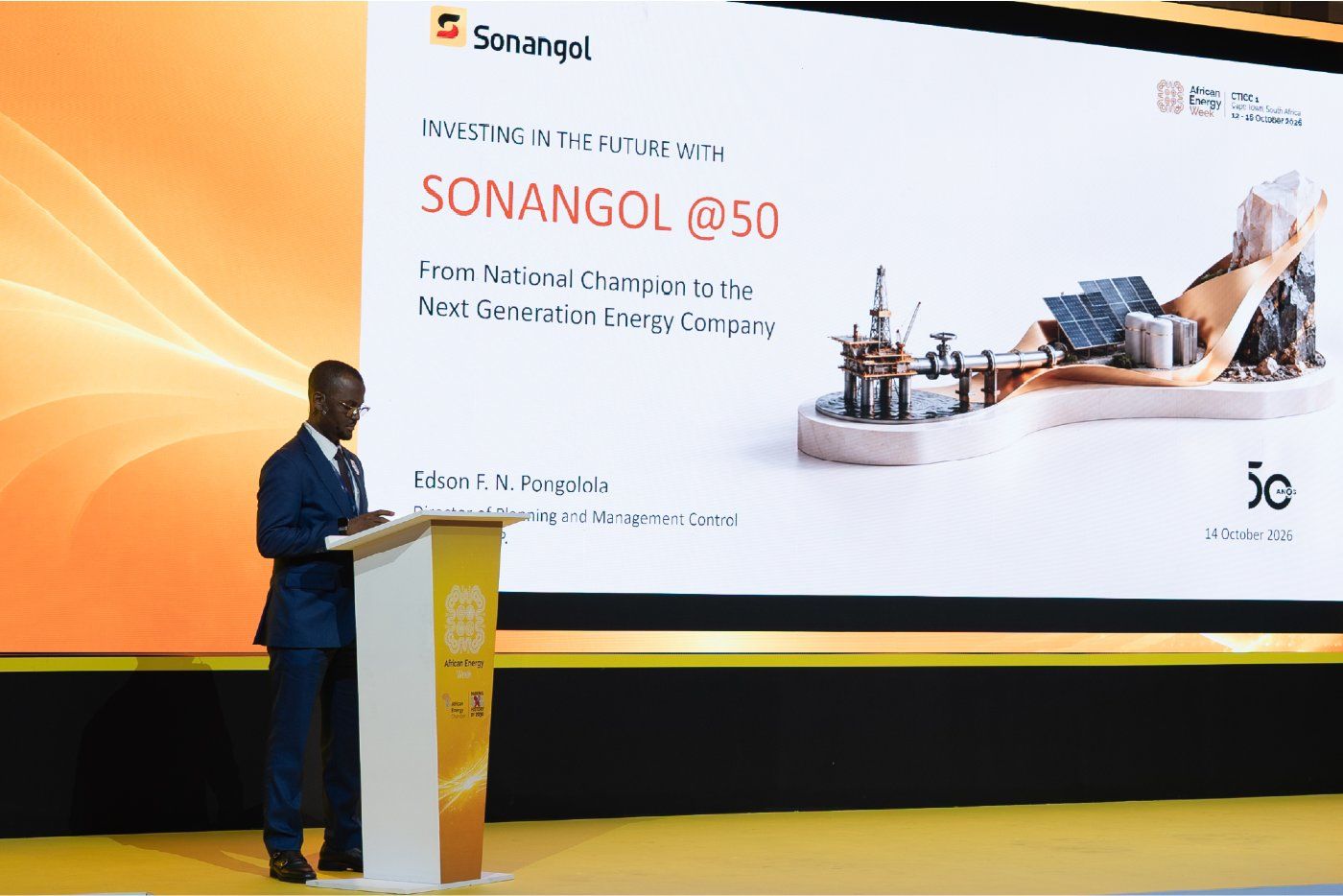
Angola’s national oil company Sonangol is targeting a 10% increase in operated production by 2030, supported by new exploration, accelerated field development and stronger partnerships with international oil companies (IOCs). Speaking during the Invest in the Future with Sonangol @50 forum at African Energy Week (AEW) 2026 in Cape Town, company executives outlined the next phase of Sonangol’s growth strategy as it celebrates its 50th anniversary, with upstream investment, gas monetization and refining expansion central to its ambitions.
Edson Pongolola, Director of Planning and Management Control at Sonangol, said the company currently participates in 48 concessions, operating 11, and is pursuing higher production alongside expanded downstream capacity. The company is also targeting 265,000 barrels per day (bpd) of refining capacity as part of Angola’s wider ambition to reach 425,000 bpd.
“Every commitment must translate into production and efficiency,” Pongolola said, emphasizing the importance of leveraging Angola’s resources to strengthen industrial development, energy security and economic growth.
Partnerships with IOCs represent a strategic anchor of this growth strategy, enabling Sonangol to accelerate exploration, develop existing discoveries and maximize the value of established infrastructure. During the forum’s Upstream Partnerships panel, Ricardo Van-Deste, CEO of Sonangol E&P, identified the Kwanza Basin as a priority for the next generation of deepwater projects, building on developments such as Kaminho and recent appraisal activity at Block 24.
“We have said that the next wave of deepwater developments need to come from the Kwanza Basin. This wave is already here with the Kaminho development,” Van-Deste said. “We need more Kaminhos and Katambis.”
He emphasized the need to shorten the time between discovery and production, advance undeveloped marginal fields and explore shared infrastructure models to reduce costs. These measures will be essential to Angola’s ambition of maintaining national production above one million bpd over the next decade.
Richard Migeon, Director of Business Strategy at TotalEnergies EP Angola, reinforced the importance of appraisal drilling and infrastructure-led development. Referencing Kaminho, he explained that evaluating existing discoveries helped establish sufficient resources to justify investment, while subsea tiebacks could unlock smaller accumulations without requiring standalone production facilities.
“Partnerships with Sonangol are of high value for us. Collaboration is part of our DNA,” Migeon said. He added that TotalEnergies is pursuing deeper opportunities in Blocks 17 and 32 alongside frontier exploration and enhanced recovery from mature fields.
Sarah Trend, Head of Exploration – Sub-Saharan Africa at ExxonMobil, highlighted the role of advanced seismic imaging, reservoir characterization and regulatory reforms in extending the productive life of established assets such as Block 15.
“The combination of these technologies, existing infrastructure and partnerships are setting the stage of long-term value creation,” Trend said, emphasizing the importance of improving recovery while identifying new exploration opportunities.
Gas development was also positioned as a strategic growth priority among the IOCs. Kristian Svendsen, Asset Development General Manager at Chevron, highlighted the New Gas Consortium's start-up in 2026 and Angola LNG as examples of how partnerships can commercialize previously underutilized resources.
“We can build on these as we look into the future,” Svendsen said, pointing to opportunities to expand Angola’s gas value chain through existing infrastructure and additional offshore resources.
During the Beyond the Barrel fireside discussion, Osvaldo Inácio, Executive Board Member at Sonangol, outlined the company’s broader investment priorities, including capital allocation, downstream integration and selective diversification into critical minerals.
“Upstream remains fundamental and the bedrock of our operations,” Inácio said, adding that recent gas exploration success at Block 24 could create opportunities across LNG exports, gas-to-power and industrial supply.
“We will be doubling down to find gas,” he emphasized.